Friday, 9 March 2012

Encoder/Decoder Model

Stuart Hall           Encoding Decoding Model

1 Media Studies tends to focus on one of three key areas.
Institution
Who produces the text and why. Questions we might ask are what social background are the producers or what budget do they have.
Content
This is where we study the Media Text itself. We might explore genre or narrative or representation.
Audience
Here we are interested upon who the audience are and what impact the text might have upon them.
2 All those who make media texts can be referred to as encoders. Encoders create meaning. When they produce a media text they do so with an assumption of how the text will be understood.
3 The audience all take meaning out of a text. When we watch a film or listen to music we decode the meaning. We try and understand what the encoder is trying to communicate. We can therefore refer to the audience as decoders.
4 As we know all signs are polysemic, therefore all media texts are polysemic. As we are all individuals we must therefore decode media texts in different ways. Stuart hall suggests there are 4 ways in which Media Texts are decoded. We can say that the audience can read/decode a text in one of the following ways.
4 Decoding possibilities
  • Dominant reading: the reader fully shares the text’s code and accepts and reproduces the preferred reading.
  • Negotiated reading: the reader partly shares the text’s code and broadly accepts the dominant reading, but sometimes resists and modifies it in a way that reflects their own position, experiences, and interests.
  • Oppositional reading: the reader is in a social situation that places him or her in direct opposition to the dominant code. The reader understands the dominant reading but does not share the text’s code and rejects the reading, bringing to bear an alternative frame of reference.
  • Aberrant reading: the reader is unable to take the meaning that the encoder put into the text. There is a gap (dissonance) between the cultural assumptions of the encoder and the cultural context of the decoder. They just don’t get it.
5 Media Producers (encoders) will often want their audience to take the dominant reading. To ensure a text is less polysemic and less open to multiple meanings they may try and anchor meaning.
6 Encoders need to talk to their audience in the appropriate way. We call this the Mode of Address. Generally encoders will make assumptions about the decoders’ (audience) knowledge, interests and understanding of the world and encode their texts accordingly. Those assumptions are cultural and can have an impact upon the audience.
Consider girls’ magazines.
7  The assumed language and points of reference an encoder uses to connect with an assumed target audience is known as the ‘Public Idiom.’


Thursday, 1 March 2012

Kerrang music magazine research


Kerrang magazine was published on June 6th 1981. From research I have found out that the current circulation sales are 52,272 and around 50,128 in the UK and Republic or Ireland. These sales were last established in July 30th 2011 to January 18th 2012.  However I additionally found out the total circulation sales for July 2008 where the sales were around 50,000 therefore this shows that the sales have increased slightly. Kerrang competitors are NME from researching the total circulation sales for NME they sell around 35,000 copies from July 2011 to December 30th 2

011.
Kerrang magazine is published by Baurea media group. The company is is a large German publishing company based in Hamburg, which operates in 15 countries worldwide therefore operates at a global level. Since the company was founded in 1875, it has been privately-owned and under management by the Bauer family. The company turned over 1.79 billion last year. Baurea involves media in wide range of different aspects including radio, magazine and television.  Baurea media group are horizontal integration and cross media ownership because it owns different aspects of media.
This the Kerrang magazine's rate card:
Baurea media group conveys convergence as it is a media industry and uses different types of media.  It also uses synergy as a result of promoting its magazine on its radio show. And promoting TV programmes from their magazines i.e. the Kerrang magazine. The magazine uses synergy in order to advertise the bands on this cover which will sell their magazine if the artist is well known or popular; in turn the magazine will advertise the band's new single, album or tour to help the artist make money. Kerrang magazine; although it's popular it's not necessarily a mainstream magazine. This idea shows that it's okay to like things other than what the majority like, and it's okay to be a little different which an important statement to make is. Magazines are published to promote the companies different sources of media through the magazine. The Kerrang magazine makes money by advertising different companies.
The relationship between the internet and my magazine is that both portray advertising for there TV shows and radios, on the website I found this:
This shows that the sky channel Kerrang is being advertised on their website. This shows that the relationship between both internet and magazine is advertising off their own media sources. The magazine is not really conveyed online, Baurea don’t display their Kerrang magazines online, and in addition the magazine falls into its own unique platform for rock genre. Therefore there are not many benefits of not displaying the publication online, apart from the fact if people are eager to view the magazine they will have to buy the magazine in stores.
There is a clear relationship between the encoder and the decoder, with the advantages of modern technology such as web 2.0 technologies this helps interact collaborate with each other in a social media dialogue as creators. The encoder now has created magazine that are designed specifically for their target audience’s in Kerrang’s perspective  they use information about upcoming giggs this appeals to their target audience therefore they are more likely to buy the magazine furthermore, by advertising these giggs or festivals my result in the giggs paying to advertise about their giggs and festivals.
The magazine attracts its target audience by using mode of address the encoder uses assumptions about the decoders interests i.e. as I have already discussed using information about upcoming giggs, however it also uses addition items to help intense customers, such thing like posters, calendars and cd’s all free items included within the magazine. In addition Kerrang uses new ideas to anchor more decoders, by directly addressing the audience the music magazine has a letter on its front cover from the editor, this makes the decoder feel more involved with the making of the magazine.

Contents Page

Friday, 9 December 2011

Planning Photo Shoot for Double Page Spread

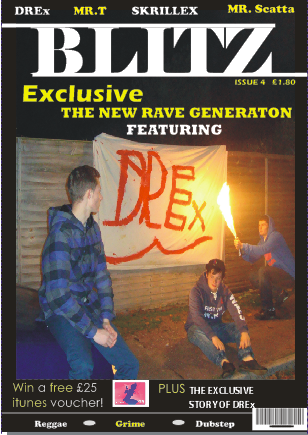
My fist photo in my planned photo shoot I want to plan a football of “DREx” playing pool, showing that they don’t just get up to crazy shenanigans. Also my front cover promises to tell the exclusive DRex life story and how the band met playing pool in the pub. My picture will include all 3 members in the shot, playing pool in one of their conservatories. This shot will be a medium shot.  


My next shot goes back to the crazy look with only two members in the shot one with yellow face paint and the other with looking “normal” this photo shows the contrast between crazy dubstep and normal hip hop, the other member in the photo dressed normal will not be a member of the “DREx showing the change from hip hop to dubstep, the background will be white. This shot wil be a close up shot.

Front cover

Thursday, 1 December 2011

Mock up double page spread


I have chosen this double page spread because its stands out to the decoder. Furthermore, it also appeals to my target audience. The double page spread conveys a sign of graffiti in addition the clothing these clusters of signs results in paradigmatic connation of the overall dubstep theme. The interpellation in the double page spread is where the bold white masthead interpellates with the statement “oh how I become famous”. The changes I will make based on this template for my double page spread will be a different layout of pictures with more people being involved in the pictures I also want to balance the text with more picture therefore I aim to break the text up and make it more appealing with bright pictures that draw the encoders attention to my boy band. The mode of address in this double page spread is using questions and answer with a colloquial language.

Although there are a few things that i would change on my double page spread, i would like more pictures it breaks up the text and looks effective, on my inspiration double page spread there are fairly any pictures so this needs to be changed. In addition, i also want to change the "top 10 dubstep songs" i believe this is not relevant to what i aim to do and readers dont want half a page of space used by top 10 dubstep  songs.